The Performance Impact of Values-Based Restrictions
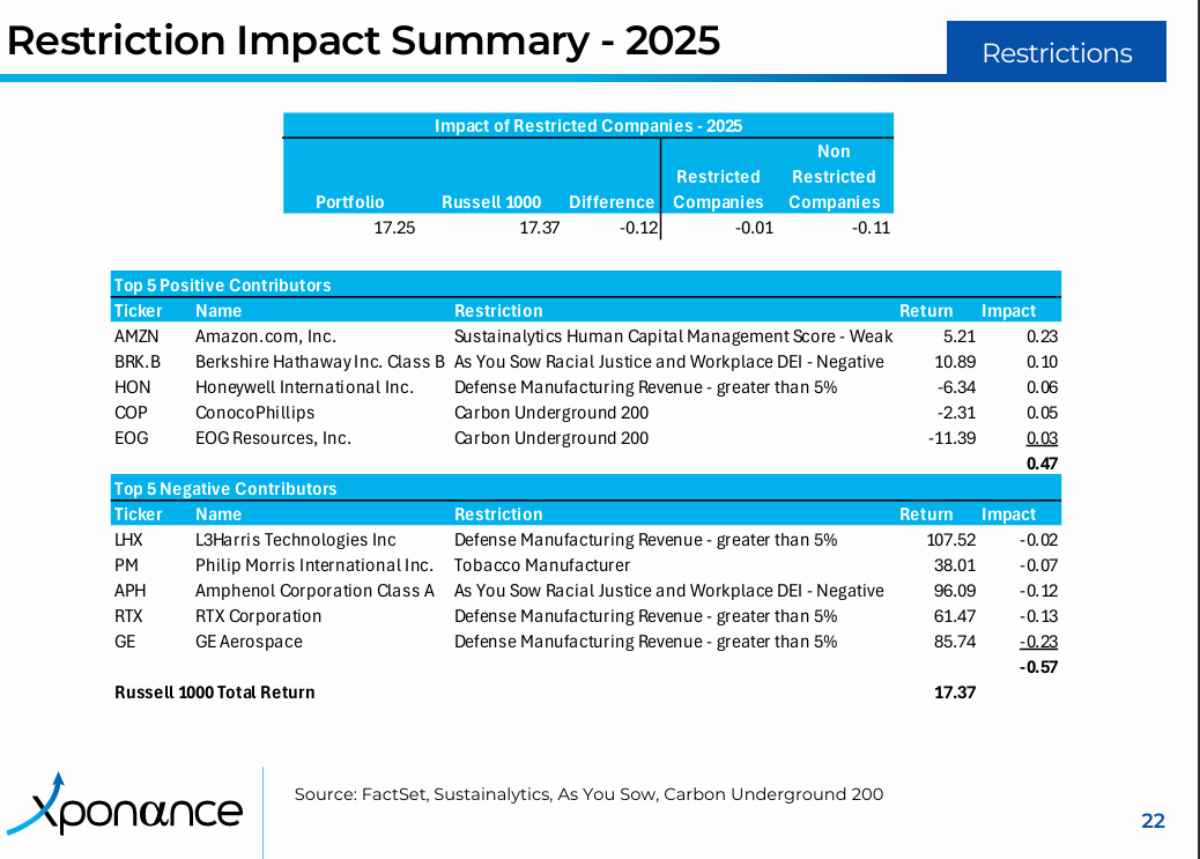
In a recent portfolio review with the Endowment’s Investment Committee, US large stock portfolio manager Xponance provided a clear, quantitative look at how values-based investment restrictions affected performance in 2025, an issue frequently raised by investors seeking to values alignment with suitable investment returns. For those quantitatively curious, their findings are presented below in detail.
The key takeaway is that the net performance impact of Endowments UU values restrictions was modest and transparent. The portfolio returned 17.25% over the period, versus17.37% for the Russell 1000 index, a difference of just –0.12%, or **12 basis points, that is attributable largely to restricted securities. Importantly, this small gap was not driven by broad themes, but by a small number of highly concentrated stock-specific returns.
On the positive side, several excluded companies with weaker sustainability, human capital, or DEI scores underperformed, which helped relative results. For example, restrictions tied to Sustainalytics Human Capital scores, Carbon Underground 200 exposure, and As You Sow racial justice metrics added value where related excluded companies lagged the benchmark. Conversely, the largest negative performance contributors were a handful of restricted defense-related and tobacco companies—such as GE Aerospace, RTX, Philip Morris, and L3Harris —that posted strong absolute returns in 2025.
Xponance emphasized that this pattern underscores an important distinction for investors: restrictions may not introduce persistent underperformance, but rather episodic differences tied to narrow stock market leadership. Over time, these effects are expected to wash out across economic cycles, while still allowing investors to remain aligned with clearly articulated values and stewardship goals.
For investors, the implication is straightforward: values-aligned restrictions, where implemented with discipline and monitored rigorously, resulted in a small, explainable performance difference—and likely not a structural performance penalty. It is important to note, this is a one-year analysis, we’ll look to update and share these findings over the coming years.